China Best Attenuating Exam Gloves for Global Buyers
Global buyers searching for China Best Attenuating Exam Gloves need more than a low unit price. They need clear product definitions, consistent specifications, and evidence that matches the intended use. “Attenuating” is not a universally understood exam-glove category, so buyers should clarify what performance they mean before comparing suppliers. Is it reduced tactile sensitivity, a specified barrier property, or another measurable feature? Details matter.
Dr. Benedetta Allegranzi, a World Health Organization infection-prevention expert, has emphasized the importance of hand hygiene alongside glove use. A practical paraphrase of that guidance is: “Gloves do not replace hand hygiene.” That distinction belongs in every responsible purchasing discussion. Gloves are one part of a broader infection-prevention process, not a shortcut around it.
A useful supplier review looks closely at material, thickness, sizing, finish, packaging, and batch-to-batch consistency. Ask for current technical documents and independent test reports, then check that the reported methods match the claims being made. Inspect samples, too. A glove that feels smooth under bright showroom lights may behave differently during a long procedure, when fingertips sweat and cuffs are repeatedly adjusted. Small details can change the user experience.
This guide examines how global buyers can assess Chinese suppliers, compare product claims, and identify questions worth asking before an order. It also leaves room for caution: specifications do not tell the whole story, and a polished catalogue is not proof of dependable production. Verify what you can. Notice what remains unclear.
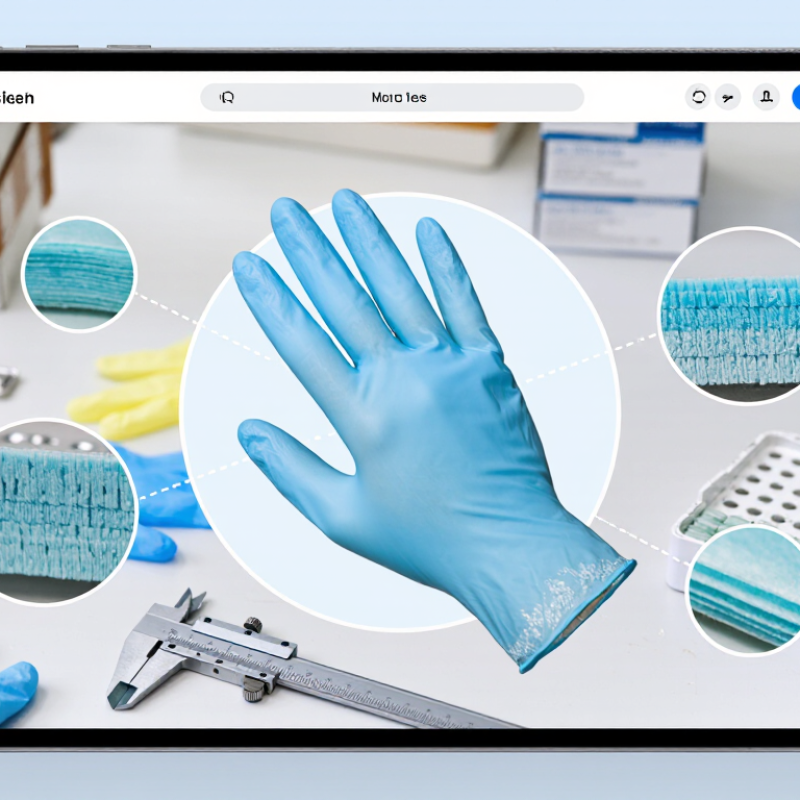
Define Medical Exam Gloves by Material: Nitrile, Latex, and Vinyl
Medical examination gloves differ by material, and the right choice depends on the task, fit, and expected exposure. Nitrile is a synthetic rubber that offers a useful balance of flexibility and resistance to many common substances. It is often chosen when latex proteins are a concern. Check product specifications rather than assuming every nitrile glove performs the same way.
Latex gloves are made from natural rubber. Their stretch and close fit can support precise hand movements, such as handling small instruments. However, some people are sensitive or allergic to latex proteins, so workplace needs should guide selection. Fit matters, too. A glove that is too tight can tire fingers; one that is loose may reduce control.
Vinyl gloves, usually made from PVC, can suit brief, lower-risk tasks where frequent changes are practical. They generally stretch less and may fit less closely than latex or nitrile. Not a perfect shortcut. Material alone does not establish protection: thickness, construction, sizing, and tested performance all matter. Review the manufacturer’s technical information, inspect gloves for damage, and replace them if torn or contaminated. In real use, comfort can be overlooked, yet uncomfortable gloves may lead to poor fit or inconsistent wear.
Verify Nitrile Gloves Against ASTM D6319 and FDA 510(k) Requirements
When evaluating nitrile examination gloves, check the exact product against ASTM D6319, the standard covering nitrile examination glove requirements. Review test reports for dimensions, tensile properties, and other specified performance measures. Confirm that the report names the same model and material as the packaging. A standard reference alone is not proof of compliance. Details matter.
For the U.S. market, verify the glove’s FDA 510(k) status using the FDA database. Match the listed device and manufacturer to the product offered, then compare its intended use with the labeling. A 510(k) clearance is not a blanket endorsement of every glove from a supplier. Ask for current documentation, such as a declaration of conformity and lot-specific quality records. Paperwork can look complete and still leave gaps; check dates and product identifiers carefully.
Tips: Request a sample from the production lot you plan to buy. Inspect the cuff, fingertips, and packaging for defects, and confirm the lot number is traceable. If a report uses a different model name, ask for clarification before placing an order.
Compare the AQL 2.5 Exam-Glove Limit with AQL 1.5 Surgical-Glove Criteria
For global buyers, AQL helps compare exam gloves with surgical gloves, but it is easy to misread. An AQL 2.5 limit generally allows more defects in a sampling inspection than an AQL 1.5 criterion. The lower figure is stricter. Neither figure guarantees that every glove is defect-free or states the exact defect rate in every shipment. Results depend on the sampling plan, inspection level, and applicable standard.
Buyer tip Ask for the test report and the sampling plan used. Check that the AQL claim applies to the glove type and production lot you are buying. A certificate alone may not answer every question.
AQL is only one purchasing measure. Confirm whether the gloves are intended for examination or surgery; these products are not interchangeable. Review the stated standard, material, size range, packaging, and relevant quality records.
For example, inspect how the supplier identifies lots and handles failed samples. AQL 2.5 may suit an exam-glove specification, while surgical-glove requirements may call for AQL 1.5. Requirements vary by market and standard, so verify the exact criteria before ordering. The number helps, but it does not tell the whole story.
Compare Fit, Thickness, Packaging, and Shipment Costs for Global Buyers
Global buyers should compare fit before price. ASTM D6319-19a sets requirements for nitrile examination gloves, including dimensions and physical properties; it does not make every glove feel equally usable. Request samples in several sizes, then test them during realistic tasks. A glove that pulls at the thumb can slow hand movement. One that wrinkles at the fingertips may reduce control. Check measured thickness at the palm and fingertips, not just a single advertised figure. A thicker glove may offer more material, but can also feel less dexterous. There is no perfect trade-off.
Packaging changes the landed cost. Compare gloves per box, boxes per carton, and cartons per pallet. A compact carton may reduce freight volume, while oversized cartons can leave costly unused space. Ask suppliers to state net weight, gross weight, carton dimensions, and pallet configuration. These details help freight forwarders price shipments consistently. Small differences add up.
The World Bank’s 2023 Logistics Performance Index assessed 139 countries across six areas, including customs, infrastructure, tracking, and timeliness. It is a useful reminder that delivery risk varies by route, not only by supplier. Compare quoted transit times with recent lane performance, and budget for port delays. I would still treat estimates cautiously; actual costs can shift with season, fuel, and cargo space. A low unit price can disappoint when cartons arrive late or freight is billed by volume.
China Exam Gloves for Global Buyers: Fit, Thickness, Packaging & Shipping
Compare representative thickness ranges by material. Specifications and packing formats vary by product; confirm them with the supplier before ordering.
Fit: Latex and nitrile gloves are generally designed for a closer fit; vinyl gloves may feel looser. Fit also depends on sizing and the glove’s specific design.
Packaging: A common retail format is 100 gloves per dispenser box, often packed 10 boxes per carton. Confirm the actual count, carton dimensions, and gross weight on the quotation.
Shipping costs: There is no single comparable cost without an origin, destination, shipment size, freight mode, and Incoterm. Request a quote using the carton dimensions and gross weight.
Thickness values are indicative planning ranges in millimeters, not universal specifications or regulatory limits. Check the product data sheet for the exact glove being purchased.




 Reliability
 Integrity
 Teamwork
 Looking for the
 Register as