Why Choose Joint Robotics Technology for Global Sourcing?

Global sourcing is becoming a technology decision, not merely a purchasing exercise. Joint robotics technology connects robot manufacturers, system integrators, component suppliers, and end users across borders. It can improve production consistency while reducing dependence on a single supplier. However, technology partnerships require evidence, not attractive promises.

The International Federation of Robotics reported 541,302 industrial robots were installed worldwide in 2023. Its World Robotics 2024 report also recorded more than four million robots operating globally. These figures show strong automation demand, especially in automotive, electronics, logistics, and general manufacturing. For sourcing teams, the opportunity is practical: a robotic arm, vision camera, and controller can work together on a real assembly line. Yet market growth does not guarantee project success.

Details matter.

A reliable partnership should demonstrate tested hardware, documented safety practices, local service coverage, and transparent total ownership costs. Deloitte’s 2024 Global Manufacturing Survey highlights continuing pressure to improve productivity, resilience, and workforce capabilities. Joint robotics technology can support these goals when suppliers share engineering knowledge and maintenance responsibilities. It may also shorten integration time through compatible software and standardized interfaces. Still, this approach is not automatically cheaper. Training gaps, communication delays, spare-part logistics, and unclear accountability can weaken the expected return. The IFR data describes industry scale, but it cannot measure every factory’s practical constraints. That limitation deserves attention. Global sourcing decisions should therefore combine independent reports, factory trials, reference checks, and measurable performance targets. The strongest partnership is not always the largest one. It is the one that performs reliably on the customer’s production floor.
Why Choose Joint Robotics Technology for Global Sourcing?

Definition and Scope of Joint Robotics Technology

Why Choose Joint Robotics Technology for Global Sourcing?

Definition and Scope of Joint Robotics Technology

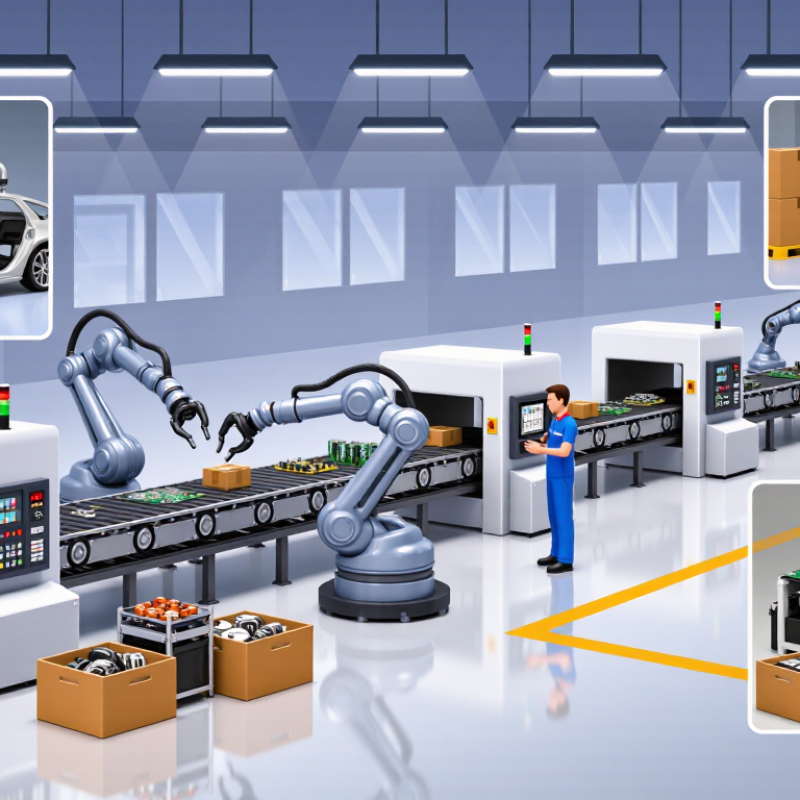
Joint robotics technology refers to coordinated systems that combine robotic arms, sensors, software, tooling, and human decisions. The term is not perfectly fixed. In sourcing projects, it often describes several machines working together through shared control logic and data.

Its scope reaches beyond the robot itself. It includes grippers, vision systems, motion controllers, safety equipment, communication interfaces, maintenance tools, and production software. A global sourcing team also evaluates spare parts, operator training, installation support, and local service capacity. These details affect reliability more than a product brochure suggests.

On a factory floor, a small calibration error can leave parts misaligned by several millimeters. I have seen cycle times improve after teams adjusted lighting, fixtures, and movement paths. The robot was not the only solution. Careful testing matters.

Joint systems require clear technical documents and measurable acceptance criteria. Teams should check payload limits, repeatability, energy use, data security, and emergency stopping functions. They should also confirm compatibility with local electrical systems and workplace requirements. Documentation builds trust. Yet, even strong specifications can miss practical problems, such as difficult cleaning access or delayed replacement components.

Global sourcing benefits when suppliers explain limitations honestly. A capable partner shares test records, integration risks, and maintenance intervals. That evidence supports better purchasing decisions. It also exposes weaknesses early, which is uncomfortable but necessary. Fresh automation projects rarely perform perfectly on the first trial.

Why Choose Joint Robotics Technology for Global Sourcing?

Definition and Scope of Joint Robotics Technology

Joint robotics technology refers to integrated human–robot systems in which collaborative robots, industrial robots, sensors, safety controls, software, and end-effectors work together with human operators. Its scope covers assembly, material handling, welding, packaging, quality inspection, machine tending, and flexible production.

The chart shows manufacturing robot density in 2023, measured as operational industrial robots per 10,000 manufacturing employees. Higher density indicates a stronger manufacturing ecosystem for automation integration and robotics sourcing. Source: International Federation of Robotics, World Robotics 2024.

Core Technologies Supporting Global Sourcing

Why Choose Joint Robotics Technology for Global Sourcing?

Core Technologies Supporting Global Sourcing

Joint robotics technology connects sensing, software, and human decision-making across sourcing operations. Machine vision checks dimensions, labels, and surface defects in seconds. Collaborative robots then handle repetitive picking, packing, and palletizing tasks. The International Federation of Robotics reported 541,302 industrial robots were installed worldwide in 2023. This growth shows strong demand for flexible automation, not only faster production.

Data integration matters just as much. IoT sensors can monitor temperature, vibration, location, and equipment health during production and transport. Digital twins help teams test workflow changes before spending money on physical redesigns. The World Bank’s 2023 Logistics Performance Index recorded global cargo pickup times ranging from about 2.5 to 220 hours. That gap exposes why real-time visibility and predictive maintenance support more reliable sourcing decisions. Yet technology alone cannot solve poor supplier data. That remains an uncomfortable weakness.

Tips: Start with one measurable process. Track cycle time, defect rates, energy use, and recovery speed. Use open data interfaces where possible. Train operators beside the machines, not after installation. Review cybersecurity controls regularly. Small pilots reveal hidden costs. They also challenge optimistic assumptions.

Human oversight remains essential when sourcing across regions, regulations, and production cultures. Robotic systems can flag anomalies, but experienced teams must interpret unusual materials, packaging, or delivery conditions. A practical deployment combines robotics, traceability, secure cloud platforms, and clear escalation rules. The result is not perfect automation. It is a more visible, adaptable, and evidence-based sourcing network.

Why Choose Joint Robotics Technology for Global Sourcing? - Core Technologies Supporting Global Sourcing

Core Technology Typical Technical Data Global Sourcing Value Key Verification Criteria Relevant Standards or Practices
Multi-Axis Joint Structure Common industrial configurations include 4–6 rotational axes; articulated reach is typically about 0.5–3.0 m, depending on application class. Supports flexible deployment for assembly, handling, welding, inspection, and machine tending across different production sites. Axis count, working envelope, repeatability, mounting orientation, allowable wrist moment, and cycle-time requirements. Robot performance should be evaluated against the application requirements defined in ISO 10218.
Servo Motor and Drive System Closed-loop servo control uses position feedback and coordinated motion control; speed, torque, and acceleration are selected according to payload and cycle time. Improves motion consistency and enables standardized performance checks when comparing suppliers from different regions. Continuous and peak torque, thermal limits, acceleration, braking behavior, power consumption, and maintenance access. Use documented servo-tuning procedures, overload protection, and traceable factory acceptance testing.
Precision Reduction Mechanism Common mechanisms include harmonic, planetary, and cycloidal reducers; reduction ratios are selected to balance torque, speed, backlash, and service life. Stable transmission accuracy helps maintain consistent product quality when equipment is sourced, installed, or serviced internationally. Backlash, torsional stiffness, rated torque, allowable radial and axial loads, lubrication method, and expected duty cycle. Supplier documentation should include load ratings, inspection tolerances, lubrication requirements, and replacement procedures.
Absolute Position Feedback Absolute encoders retain joint-position information without requiring a full reference search after every power cycle; resolution varies by encoder design and control architecture. Reduces commissioning time and supports repeatable installation across multiple factories and countries. Position resolution, calibration stability, data backup, zero-position retention, and recovery behavior after power loss. Require documented calibration methods and a controlled process for encoder replacement or joint servicing.
Force, Torque, and Collision Detection Monitoring may use motor current, joint torque estimation, or dedicated force/torque sensors; sensitivity depends on payload, tooling, and control settings. Supports safer operation, delicate handling, insertion tasks, and faster adaptation to variations in globally sourced components. Detection threshold, response time, stopping distance, false-trigger rate, sensor drift, and tool-center-point calibration. Collaborative applications require risk assessment and validation according to ISO/TS 15066 and applicable machinery-safety rules.
Machine Vision Integration 2D vision is suitable for location and inspection tasks; 3D vision adds height or spatial information for bin picking and irregular parts. Enables flexible handling of different component lots, packaging formats, and supplier-specific part variations. Detection accuracy, field of view, lighting stability, calibration repeatability, processing time, and tolerance to surface variation. Validate the complete vision-to-robot coordinate transformation and test representative production samples.
Industrial Communication Real-time industrial Ethernet and fieldbus connections can synchronize motion, safety signals, sensors, and programmable controllers. Improves interoperability and reduces integration risk when equipment originates from different countries or automation ecosystems. Supported protocols, update time, network topology, diagnostic functions, cybersecurity controls, and interface documentation. Request protocol conformance information, electrical interface specifications, and documented data-mapping procedures.
Functional Safety Typical functions include emergency stop, protective stop, speed limitation, safe torque off, door interlocking, and safety-rated monitoring. Creates a consistent safety baseline for deployment, acceptance testing, and operator training across international facilities. Safety function response time, stopping performance, fault diagnostics, reset logic, validation records, and risk-reduction measures. Assess the robot cell according to ISO 10218, ISO 13849, IEC 62061, and applicable local regulations.
Environmental Protection and Serviceability Protection levels such as IP ratings describe resistance to dust and water; the required rating depends on washdown, particles, humidity, and temperature. Helps match equipment to regional factory conditions and lowers the risk of premature failure caused by unsuitable environmental protection. Ingress protection, operating temperature, humidity limits, cable routing, grease intervals, spare-part availability, and service documentation. Verify IP claims against IEC 60529 and request lifecycle maintenance instructions before purchase.
Digital Commissioning and Data Traceability Digital backups may include robot programs, parameter files, calibration records, alarm histories, and revision-controlled inspection data. Shortens deployment time, supports remote troubleshooting, and improves consistency when the same process is replicated across global production locations. Backup format, access control, version history, restore testing, program compatibility, and availability of multilingual technical documents. Use documented change control, acceptance protocols, cybersecurity practices, and structured spare-parts identification.

Note: Technical values are representative engineering ranges or evaluation criteria. Final specifications should be confirmed against the selected robot configuration, tooling, production cycle, environmental conditions, and applicable regional safety requirements.

How Joint Robotics Technology Streamlines Sourcing

Why Choose Joint Robotics Technology for Global Sourcing?

How Joint Robotics Technology Streamlines Sourcing

Joint robotics technology connects engineering, purchasing, and quality teams through one sourcing workflow. Product requirements become measurable data, including payload, reach, cycle time, safety needs, and service conditions. This reduces vague requests and helps suppliers quote comparable solutions. In practical projects, shared specifications also expose missing details before production begins. That prevents expensive revisions later.

The system can compare qualified suppliers using capacity, technical fit, delivery history, and documentation. Automated records support traceability from quotation to sample approval and final inspection. Teams can review drawings, test results, certificates, and corrective actions in one controlled workspace. Human judgment remains essential. A machine can flag an unusual delivery pattern, but an experienced buyer must investigate its cause.

This approach also improves communication across time zones. Real-time status updates show whether tooling, programming, testing, or shipment preparation is delayed. Early warnings create room for realistic adjustments. No system is flawless. A supplier score may look precise while hiding weak local support or unclear maintenance responsibility. Regular audits, sample checks, and direct technical discussions still matter. Careful sourcing is not fully automatic; it becomes more consistent when technology supports disciplined decisions.

Key Benefits for International Buyers

Why Choose Joint Robotics Technology for Global Sourcing?

Key Benefits for International Buyers

For international buyers, joint robotics technology can improve flexibility across different production lines. Integrated joints combine motors, sensors, reducers, and control systems in compact assemblies. This design can reduce installation space and simplify maintenance. According to the International Federation of Robotics’ World Robotics 2024 report, 541,302 industrial robots were installed worldwide in 2023. The global operating stock reached approximately 4.28 million units. Scale matters. Buyers can source proven components with broader technical support and replacement options.

Global sourcing also supports faster production changes. A robotic arm with accurate joints can handle assembly, inspection, packaging, and material movement. Buyers should compare payload, repeatability, cycle time, communication protocols, and service availability. The World Economic Forum’s Future of Jobs Report 2023 found that 44% of workers’ core skills may change by 2027. Automation can help address skill shortages, but it cannot replace process knowledge. Operators still need training, clear safety procedures, and practical troubleshooting skills.

The figures can mislead.

A lower purchase price may hide costly integration work. Voltage standards, spare-part delays, software compatibility, and local engineering capacity deserve equal attention. In my assessment, international buyers should request test videos, failure-rate records, maintenance schedules, and reference applications before signing contracts. A pilot cell is often wiser than a large rollout. It may feel slower, but weak assumptions become expensive very quickly.

Factors to Consider When Choosing a Robotics Partner

Why Choose Joint Robotics Technology for Global Sourcing?

Choosing a robotics partner requires more than comparing prices. Technical capability, communication, and long-term reliability matter equally. A qualified partner should explain payload limits, cycle times, accuracy, and maintenance needs in clear language. Ask for test data, not only attractive promises. Request references from similar production environments, especially if your factory has dust, heat, or limited floor space. The right supplier should also understand electrical standards, safety requirements, documentation, and local service expectations.

A useful evaluation includes a factory audit and a small pilot project. Watch how engineers respond when a test fails. That moment can reveal more than a polished presentation. Check software compatibility, spare-part availability, training plans, and remote support procedures. Confirm who owns technical documents and how updates are controlled. No partner is perfect. Some proposals look efficient but hide difficult integration work. That risk deserves honest discussion before payment or shipment.

Tips: Define acceptance criteria before testing. Record cycle time, error recovery, and operator training hours. Ask for a written service response plan. Keep questions specific. Compare evidence, not enthusiasm. Also review the partner’s quality controls and international shipping experience. A reliable relationship grows through transparent reporting, realistic timelines, and steady improvements after installation.

Zer0 Product Recalls

Why Shalby MedTech

We are committed to deliver solutions and transforming the way joint replacement procedures are performed.

Reliability
Integrity
Teamwork