
Choosing among Knee replacement systems in 2026 involves more than comparing implant designs or purchase prices. Hospitals and buyers must consider clinical evidence, surgeon experience, operating-room workflow, and the support available after installation. A system that fits one hospital’s staffing and patient population may not suit another. Small details matter: instrument trays, sterilization cycles, delivery schedules, and the time required to train a surgical team.
This guide introduces leading options and the practical questions behind a responsible evaluation. It considers implant design, digital planning tools, compatibility with existing equipment, supplier reliability, and the full cost of ownership. Buyers should review published evidence and consult qualified orthopedic professionals; product claims alone are not enough. Ask how a system performs across different patient needs, what follow-up data are available, and how the supplier handles training or component availability. Look closely.
There is no universal winner. Procurement teams may value predictable supply, while surgeons may prioritize familiar instruments or specific design features. Those priorities can conflict. No scorecard captures every operating-room reality, and comparisons can be imperfect when evidence or reporting methods differ. That limitation deserves attention, not concealment. Use this overview as a starting point for structured discussion, local clinical review, and careful assessment of both benefits and trade-offs before making a purchasing decision.
With more than 790,000 knee replacements performed annually in the United States, the AAOS figure gives hospitals a useful starting point for sizing the market. It is not a forecast for any single facility. Local demand depends on referral patterns, patient age, surgeon capacity, and whether procedures occur inpatient or outpatient. Volume varies.
AHRQ’s HCUP Statistical Brief 186 counted about 719,000 knee arthroplasties in U.S. hospitals in 2011. That older figure offers context, not a direct comparison with today’s AAOS estimate: care settings and counting methods differ. Buyers should check current hospital-level procedure data before translating national volume into annual case projections.
A practical purchasing scope includes more than the implant. Teams should map expected case volume, compatible instrumentation, sterilization cycles, tray storage, and staff training. For example, a busy service may need enough instrument sets to cover overlapping operating-room schedules. Low-volume sites may value simpler inventory more. These details are easy to overlook. Compare systems against documented clinical needs, workflow constraints, and published evidence, then record where evidence is limited. The numbers help frame the decision; they cannot make it for the hospital.
A market-sizing reference for hospitals and buyers
The AAOS-referenced estimate of 790,000+ procedures annually signals substantial, recurring U.S. demand. This figure is a market-sizing reference, not a forecast or a comparison of manufacturers.
Choosing a knee replacement system means comparing more than implant shape. Femoral and tibial components must work together through bending, standing, and stair climbing. Designs may preserve or replace the posterior cruciate ligament, depending on anatomy and the surgical plan. Small differences matter. A few millimeters can affect balance and range of motion, so surgeons assess alignment and soft-tissue tension during the procedure.
Materials also deserve close review. Common combinations include metal alloy components and a polyethylene bearing surface. Buyers should examine wear data, material compatibility, and available sizes, while recognizing that no material removes every risk. Fixation may use bone cement, rely on bone growth into a porous surface, or combine both approaches. Patient bone quality, surgical judgment, and follow-up needs all influence the choice.
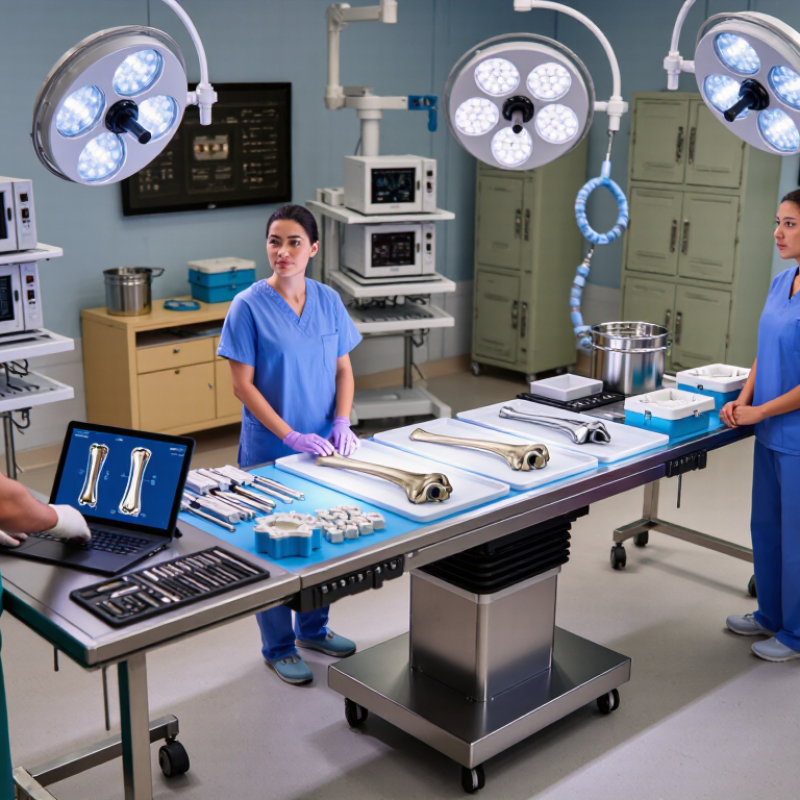
Workflow can shape outcomes too. Instrument systems may support conventional guides, computer-assisted alignment, or robotic planning. These tools can help teams measure cuts and positioning, but they do not replace clinical judgment. Hospitals should compare training requirements, setup time, sterilization steps, and instrument availability. The details can be uneven. A system that performs well on paper may still burden a busy operating room, so teams should review practical workflow data before purchasing.
A 2019 Lancet analysis estimated that 82.3% of total knee replacements remain unrevised 25 years after surgery. For hospitals and buyers, that is a meaningful durability benchmark, not a guarantee for every patient or implant. It describes revision-free survival across studied groups. It does not prove that every knee stayed pain-free or moved well. Important distinction.
A hospital comparing knee replacement systems should examine long-term registry evidence, not just short-term performance claims. Ask how many patients were followed, how outcomes were defined, and whether results apply to the hospital’s patient population. A 70-year-old with strong bone quality may face different risks from a younger, highly active patient. Surgical technique, infection prevention, rehabilitation, and follow-up also influence outcomes. The implant is only one part of the result.
There is a practical detail buyers can miss: a system that performs well on paper still needs reliable sizing options, staff training, and consistent availability. Those factors affect day-to-day care. The 82.3% figure is powerful, but it can tempt decision-makers to treat longevity as a simple product score. That would be an oversimplification. Review the evidence carefully, and discuss individual risks with qualified clinicians.
A hospital evaluating knee replacement systems should treat FDA records and AJRR data as different kinds of evidence. FDA databases can show regulatory clearances, safety communications, recalls, and reported adverse events. These records help identify questions for clinical review. They do not, by themselves, prove that one system produces better results than another. Reports may be incomplete, and an adverse-event listing does not establish cause.
AJRR annual reports offer a broader view of real-world use and outcomes across participating sites. Buyers can examine measures such as revision patterns, while checking the patient groups, follow-up periods, and definitions behind each figure. A two-year result is not the same as a ten-year result. Nor should results from different patient populations be compared as if they were identical. Small print matters.
For a practical review, teams can match FDA safety notices against registry findings, then ask surgeons and procurement staff about fit, instrumentation, training, and follow-up. Picture the actual workflow: available sizes, imaging review, and the time needed to prepare instruments. Request the underlying report date and clarify whether data cover the exact implant configuration under consideration. That matters. Public data rarely answer every local question, and a tidy comparison table can hide uncertainty. Even careful buyers may need to revise their view when newer evidence appears.
How to read this review: FDA records and registry evidence do not establish a universal “best” knee replacement system. The table compares established design and fixation choices, summarizes evidence limitations, and identifies practical checks for hospital buyers. It does not rank products or present unverified device-level outcome figures.
| System feature | Typical clinical use or design purpose | Safety and outcomes evidence | What hospitals and buyers should verify | Evidence-based assessment |
|---|---|---|---|---|
| Cemented fixation | Bone cement is used to secure one or more implant components to bone. It is an established fixation option for primary total knee arthroplasty. | Longstanding clinical use and registry experience support its role. FDA clearance or authorization alone does not show that one cemented design produces better outcomes than another. Cement-related risks should be considered in the context of the individual patient and procedure. | Review the specific device’s FDA record and instructions for use; confirm cement compatibility, instrumentation, and staff training; assess outcomes using comparable patient groups and follow-up periods. | A well-established option, but not a universal winner. Compare device-specific registry results where available rather than relying on fixation labels alone. |
| Cementless fixation | Implant surfaces are designed to support bone attachment without cement at the relevant interface. Selection depends on the implant design and patient factors, including bone quality. | Clinical use and evidence have expanded, but results are not interchangeable across designs or patient populations. FDA marketing authorization does not establish superiority over cemented fixation. | Check the FDA record and intended-use information; evaluate the evidence for the exact implant model and patient population; review local outcomes by age, bone quality, fixation method, and follow-up. | Potentially appropriate for selected patients. Do not assume that “cementless” means better or safer for every patient. |
| Fixed-bearing insert | The polyethylene insert is locked to the tibial baseplate rather than designed to move freely against it. | Fixed-bearing designs are an established option. Comparisons with mobile-bearing designs have not established a consistent advantage for every patient or outcome measure. | Confirm insert and baseplate compatibility, available sizes, instrumentation, and the evidence for the exact construct. Compare revision and patient-reported outcomes with appropriate risk adjustment. | A common design approach; evaluate the complete implant construct and local performance rather than the bearing label by itself. |
| Mobile-bearing insert | The insert is designed to move relative to the tibial baseplate, according to the specific system design. | Proposed kinematic benefits do not by themselves prove better long-term function or survivorship. Insert movement also makes design-specific complications, including insert-related problems, relevant to review. | Request model-specific clinical and registry evidence; review the device’s FDA documentation, insert-related safety information, and the hospital’s experience and revision data. | No universal outcome advantage is established by the design category alone. Consider only with a clear clinical rationale and supporting evidence. |
| Cruciate-retaining or posterior-stabilized design | Cruciate-retaining designs preserve the posterior cruciate ligament; posterior-stabilized designs use implant geometry to substitute for its function. Choice depends on the patient, ligament status, and surgical plan. | Both approaches are used in total knee arthroplasty. Neither category should be presumed superior for all patients; outcomes depend on the complete design, technique, patient factors, and follow-up. | Verify the surgeon’s experience, available component options, compatibility across components, and evidence for the exact model. Review instability, revision, and patient-reported outcomes where reported. | Patient- and procedure-specific choice. A category-level comparison is not a substitute for model-specific evidence. |
| Constrained or hinged construct | Provides additional stability when ligament insufficiency, major deformity, bone loss, or revision circumstances require greater constraint. | These constructs address more complex clinical situations and are not directly comparable with routine primary constructs. The indication and patient complexity affect interpretation of complication and revision rates. | Confirm the device’s intended use and compatible components; review evidence for the relevant primary or revision indication; assess inventory, instrumentation, and specialist support. | Indication-driven rather than a general “best” choice for routine primary knee replacement. Interpret outcome comparisons in light of case complexity. |
| Computer-assisted or robotic-assisted workflow | Uses planning, navigation, or robotic tools to support aspects of component positioning or bone preparation. It is a surgical technology, not a separate implant fixation or bearing category. | Technical accuracy measures are not the same as improved patient-reported outcomes or fewer revisions. Long-term comparative benefit should not be inferred solely from use of a robotic or navigation platform. | Evaluate the FDA status and intended use of the specific technology; review training, workflow, service costs, data governance, and comparative outcomes; distinguish platform evidence from implant evidence. | Assess as a separate capital and workflow decision. Require clinically meaningful outcome evidence before treating technology use as proof of superior results. |
A knee replacement system should be assessed by its full cost, not its implant price alone. Include instrument trays, sterilization workload, service agreements, inventory carrying costs, and staff time. Small expenses add up. A practical comparison should use projected case volume and clearly state its assumptions. Forecasts are imperfect, especially when procedure volumes change.
OR compatibility affects daily workflow. Check whether the system’s trays fit existing storage and sterilization capacity, and whether instruments support the team’s usual room setup. During a simulated case, observe setup time, instrument handoffs, and any extra equipment required. A checklist helps. Still, one successful trial may not represent every operating room or surgeon’s technique.
Training should cover surgeons, nurses, and sterile processing staff, with clear onboarding for new team members. Ask how instruction is delivered and what support is available when staff turnover occurs. Supply reliability deserves equal scrutiny: review typical lead times, back-order communication, inventory options, and procedures for urgent cases. Request documented performance information rather than relying on broad assurances. No supplier can eliminate every disruption. Buyers should also confirm that product availability and support commitments are stated in writing.
We are committed to deliver solutions and transforming the way joint replacement procedures are performed.
Looking for the
Register as